

Found in Christ
More on the good news of redemption in Christ and the particular lostness of thirty-something women.


Just last night, I was looking at Instagram and randomly clicked on the discover page, which I hardly ever do. I was confronted with two or three reels that had very similar narratives. They all featured single women and had titles like, “35 and starting over.” Their scripts were also eerily alike: these women talked about career burnout, unfulfillment from their jobs and their relationships, and not knowing who they were. Lostness, there it is again, I thought to myself.
My current stage in life is different from these women’s, and yet I have had seasons where I felt what these women described. It’s the Rory Gilmore season of life where you not only realize you are not as far along as you thought you would be, but you may actually be headed in the completely wrong direction.
A few years ago, Ada Calhoun wrote about this from the perspective of Gen X women in her book, Why We Can’t Sleep, where she argues that the new midlife crisis for her generation of women is due to the clash of being promised that they could have it all and yet finding out in their mid-30s and 40s that this was not actually the case: a successful corporate career, happy marriage, and multiple children is a feat few of us can manage. More often, there is a compromise along the way, and she chronicles how, whatever the compromise, women found themselves unhappy and unsure of who they were as a result: those with burgeoning careers but no family felt lonely and like failures. And those who had set aside their work to raise kids felt lonely and like failures, too.
At our local zoo, there was a mural up for over six years featuring women working in STEM and their contributions, and to be quite honest, this mural really bothered me. (To the point where it became somewhat of a joke in a text group with close friends…) The display didn’t bother me because I think women can’t work in STEM, but because along with six years being an inordinate amount of time for “temporary” installation, the whole project was based on the idea presented in the sign below: “If she can see it, then she can be it.”
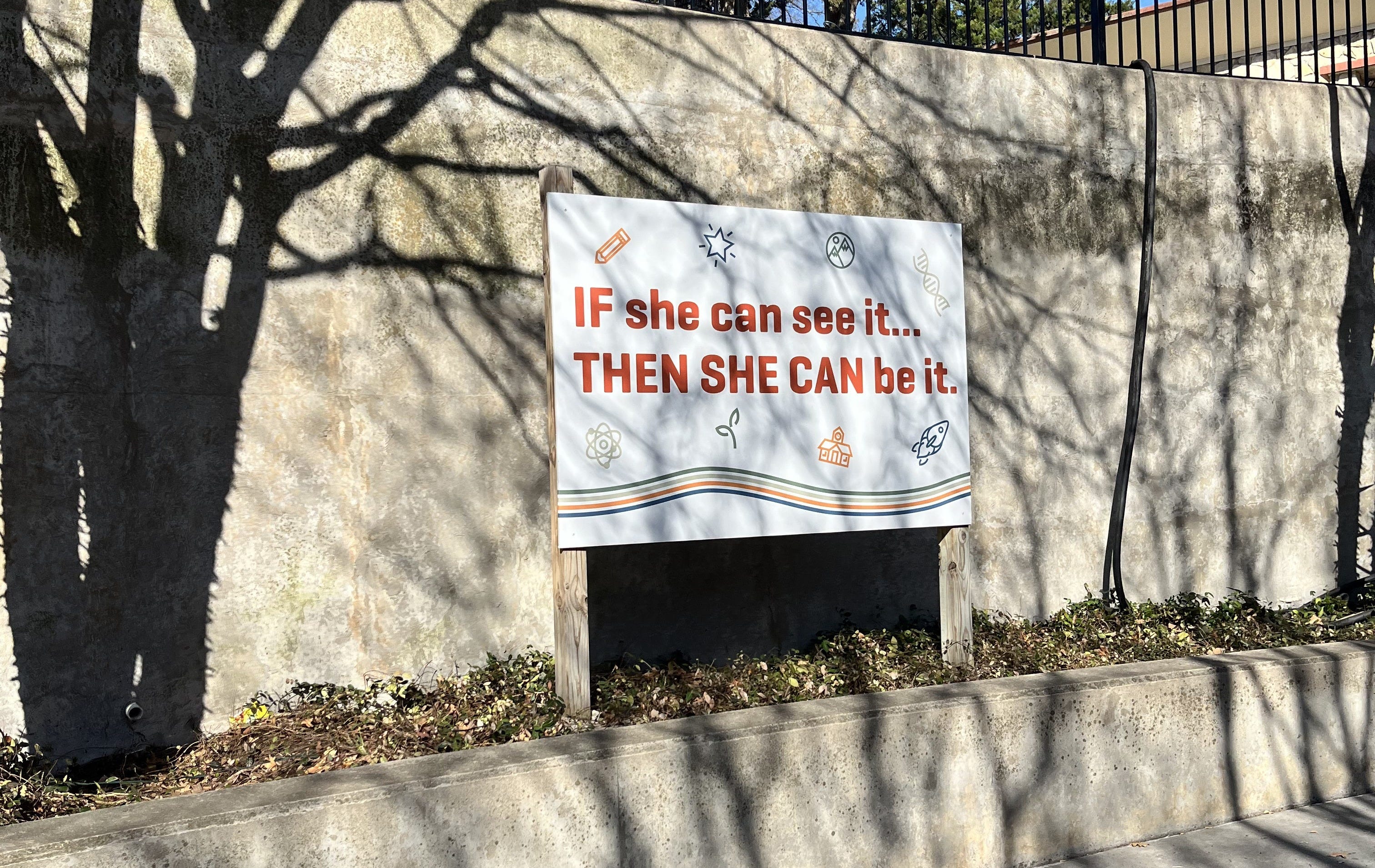
This is a lovely sentiment. I would hope if a young girl - my daughter included - is interested in the sciences, she receives all the encouragement to pursue a career in such a field. (Just as I would hope my sons receive the same.) But at some point, we have to admit that this type of messaging for anyone is not just a promise, but a threat: If you can see it and you don’t do it, what does that say about you?
I don’t think much has changed between Gen Z, and the two subsequent generations of women. The pressures to perform, to continue to shatter the glass ceiling, to have it all, continue unabated. The girl boss craze of the 2010s may have dwindled, but only because it’s been repackaged or rebranded. The same underlying message of doing it on your own, and figuring it out by yourself persists.
“Uh oh,” you may be thinking. “Is she about to go on a tirade about finding a husband? About homeschooling, having ten kids, and baking sourdough bread?”
That’s not the purpose of this piece, and let me tell you why: while the world is guilty of doling out false promises all the time, the church is guilty of doing the same. False promises that state it’s motherhood or marriage, not career, where you will, at last, find fulfillment. While I would argue (somewhere else) that marriage and family are more fundamental callings than a job will ever be, they likewise can not provide us with our ultimate restoration or purpose. Family is essential to God’s working in the world, yes, but our vocations within the family must always be an overflow of identity, not the root of it.
To be lost does mean to be unpossessed, but that’s not the whole truth. Because we are always owned by something. Something or someone will always hold our attention and guide us through life. In Isaiah 42, God proclaims that his people continue to turn away from him, yet their blindness and deafness don’t mean they don’t see or hear. It’s simply that what they see or hear isn’t God’s righteousness: “He sees many things, but does not observe them; his ears are open, but he does not hear” (Isa. 42:20). Thus, for his righteousness sake, God gives them up to their own ways (vs. 21). He lets them continue into the abyss, into their own whims and their own ways, and toward the false promises and idols which surround them, so that they are “a people plundered and looted; they are all of them trapped in holes and hidden in prisons; they have become plunder with none to rescue, spoil with none to say, ‘Restore!’” (vs. 22).
This may hit our modern ears unnecessarily harsh, and yet it’s not God’s final word in this passage (nor in general). When we turn the page to chapter 43 of Isaiah, we read this incredible opening:
“But now thus says the Lord,
he who created you, O Jacob,
he who formed you, O Israel:
‘Fear not, for I have redeemed you;
I have called you by name, you are mine’” (vs. 1).
Jesus reiterates this in the Gospel of John when he preaches about being the Good Shepherd: “The sheep hear his voice, and he calls his own sheep by name and leads them out” (John 10:3). God’s redeemed people, gathered from all corners of the earth, are individually known and identified by the same God who first made us his children. “So important are our names to God that he records them in what the Bible describes as ‘the book of life’ (see Ps. 69:28; Rev. 13:8; 20:15; cf. Luke 10:20).”1 Which is to say, he knows all about your failures, your sin, and your struggles, and he calls you anyway. What amazing news for lost sheep who have gone astray (Isa. 53:6) - whether we are those who can’t seem to find themselves in their mid-30s, or we know we are in Christ, and yet continue to try to wander back into making it on our own through comparison, success, and our own plans to secure our meaning.
The God of the universe who created and formed you, now redeems you - buying you back - from the plunderers and looters of sin, death, and the devil. It’s important to spend just a moment on how exactly he achieves this redemption, something Martin Luther is keen to do as well in his explanation to the Second Article of the Apostles’ Creed2 where he makes it explicit that Jesus’ redemption is achieved “with silver and gold but with his holy and precious blood and with his innocent sufferings and death.”3 Hebrews 9 tells us Christ’s blood is holy and precious for two reasons: It is eternal — because he is true God. And it is human — because he is true man. This holy and precious blood alone secures eternal redemption for both the sins of the whole world as well as your sins in particular.
You are not just redeemed because Christ stumbled upon you. You are found in him, returned to your original value (and more so) on account of Christ’s own blood and death. Thus, you belong to him and therefore not only do you have a redeemer but also a Lord. Martin Luther says it this way in his Large Catechism: “Let this be the summary of this article, that the little word ‘Lord’ simply means the same as Redeemer, that is, he who has brought us back from the devil to God, from death to life, from sin to righteousness, and now keeps us safe there.”4
According to our sin nature and our modern sensibilities, the idea of being owned or possessed sounds terrible. It’s the exact opposite of what 35-year-olds on Instagram are working to reclaim in response to their burnout, or what tradwives are hoping to build through their virtue and good behavior. It’s the opposite of any version of expressive individualism, whether that may manifest in some philosophy of medical freedom or bodily autonomy. To be owned, of course, profoundly means you are not your own (1 Cor. 6:19). What could be worse for a woman, in particular, in the 21st century than to be told she must answer to a Lord? And yet, when Christ redeems you and possesses you, he simultaneously frees and delivers you. His Lordship is a mark of his authority not just to guide and direct your life, but to keep you safe from all harm and evil and to bring you back to life - life as his loved and named child. Life where who you are is finally not marked by what you do, but by what he has done for you.
Christ turns ownership from threat to promise - a promise that means we aren’t owned by our sin. We aren’t owned by comparison, temptation, or failure. And we also aren’t condemned to being the masters of our own fate: of finding our way, making our meaning, or proving our righteousness to God or anyone else. Instead, we rest in the mighty hands of our Lord and Savior, because he has called us by name and claimed us.
At the end of his explanation to the Second Article of the Creed, Luther uses three words to identify the redeemed in contrast to the lost and condemned sinner. These markers describe for us what it means to not only be free from the tyranny of sin, death, and the devil, but possessed by Christ as our Lord. And every single one rests not on our performance, our seeking, our choice, but on Christ’s alone. As Luther states, under Jesus Christ we [serve him] in righteousness, innocence, and blessedness.
We are righteous on account of faith in Christ - not the law (Gal. 2:20). We are returned to a right relationship with God not because of anything we do, but through faith which receives Christ’s promise - he takes our sins upon himself, and he imputes his righteousness to us. As Christians, this is the verdict over our lives: not our careers, not our families, not our accomplishments, but the righteousness God sees when he looks at us.
This verdict is also not simply “not guilty,” but innocent. We are innocent because when Christ goes to the cross, he takes our sins with him. “Our innocence does not mean we never sin, but this sin is not held against us for the sake of Christ,” says John Pless.5 In other words, our failures do not define us. Our slate has been wiped clean so we can trust God’s words that: “I, I am he who blots out your transgressions for my own sake, and I will not remember your sins” (Isa. 43:25).
Finally, as new creations, we are given a life of blessedness. Our Lord doesn’t require servile obedience from us in order to prove our justification. Instead, when he redeems us, by the gift of faith, we are simultaneously given all his good gifts. We are remade to be receivers of God’s gifts, not self-makers or would-be creators.
Perhaps you struggle to know who you are and how you stand out in a world that moves too fast for it’s own good. Or maybe you feel burdened by guilt for what you have not become in this life, or from following a path that now feels like a dead end. Regardless, there is good news to redemption in Christ because it’s here that we find the lynchpin for all of our questions of identity. Christ’s redemption flows backward to restore us to who we are as God’s children and creatures, first made by him and intimately known by him. It flows inward to remake you into a sheep who hears the voice of your shepherd as he rescues you from yourself through his holy and precious blood. And then it flows forward, freeing you to at last turn outward in order to see to the needs of your neighbor so that your actions are no longer the foundation of who you are, but instead a gift to others. When you find yourself in a season wondering who you are and where to return, return here. Return to Jesus work for you on the cross by which you are given all righteousness, innocence, and blessedness from now into eternity.
How to Find Yourself: Why Looking Inward is Not the Answer, Brian Rosner. (Wheaton, Illinois: Crossway, 2022), 102.
More on this in my previous entry, “The Lost Creature,” but in case you don’t have the second explanation from Luther’s Small Catechism in front of you, here it is in full:
“And in Jesus Christ, his only son, our Lord: who was conceived by the Holy Spirit, born of the virgin Mary, suffered under Pontius Pilate, was crucified, dead, and buried: he descended into hell, the third day he rose from the dead, he ascended into heaven, and is seated on the right hand of God, the Father almighty, whence he shall come to judge the living and the dead.”
What does this mean?
Answer: I believe that Jesus Christ, true God, begotten of the Father from eternity, and also true man, born of the virgin Mary, is my Lord, who has redeemed me, a lost and condemned creature, delivered me and freed me from all sins, from death, and from the power of the devil, not with silver and gold but with his holy and precious blood and with his innocent sufferings and death, in order that I may be his, live under him in his kingdom, and serve him in everlasting righteousness, innocence, and blessedness, even as he is risen from the dead and lives and reigns to all eternity. This is most certainly true.
Theodore G. Tappert, ed., The Book of Concord the Confessions of the Evangelical Lutheran Church. (Philadelphia: Mühlenberg Press, 1959), 345.
Theodore G. Tappert, ed., The Book of Concord the Confessions of the Evangelical Lutheran Church. (Philadelphia: Mühlenberg Press, 1959), 414.
John Pless. Luther’s Small Catechism: A Manual for Discipleship. (St. Louis: Concordia Publishing House, 2019).
This was lovely, Kelsi, as usual 👏
I hope that word didn’t throw you. I just know that it causes anxiety when we focus too much on our identity, apart from being hidden in Christ. I feel bad for those millennials who think they failed if they’re not married, or for someone like me who never had a lasting career to even think that it matters to God.